Case study · Swag.com · 2016 — today

We helped turn a fax-and-email industry into a platform. Then Custom Ink bought it.

We have been Swag.com’s engineering partner since the very first version of the store, through the remote-work boom of 2020 and its acquisition by Custom Ink in 2021.

Client
Swag.com, New York
Industry
E-commerce · Promotional products
What we did
Product engineering, architecture, team building, investment
Team
Grew from 3 to 42 engineers
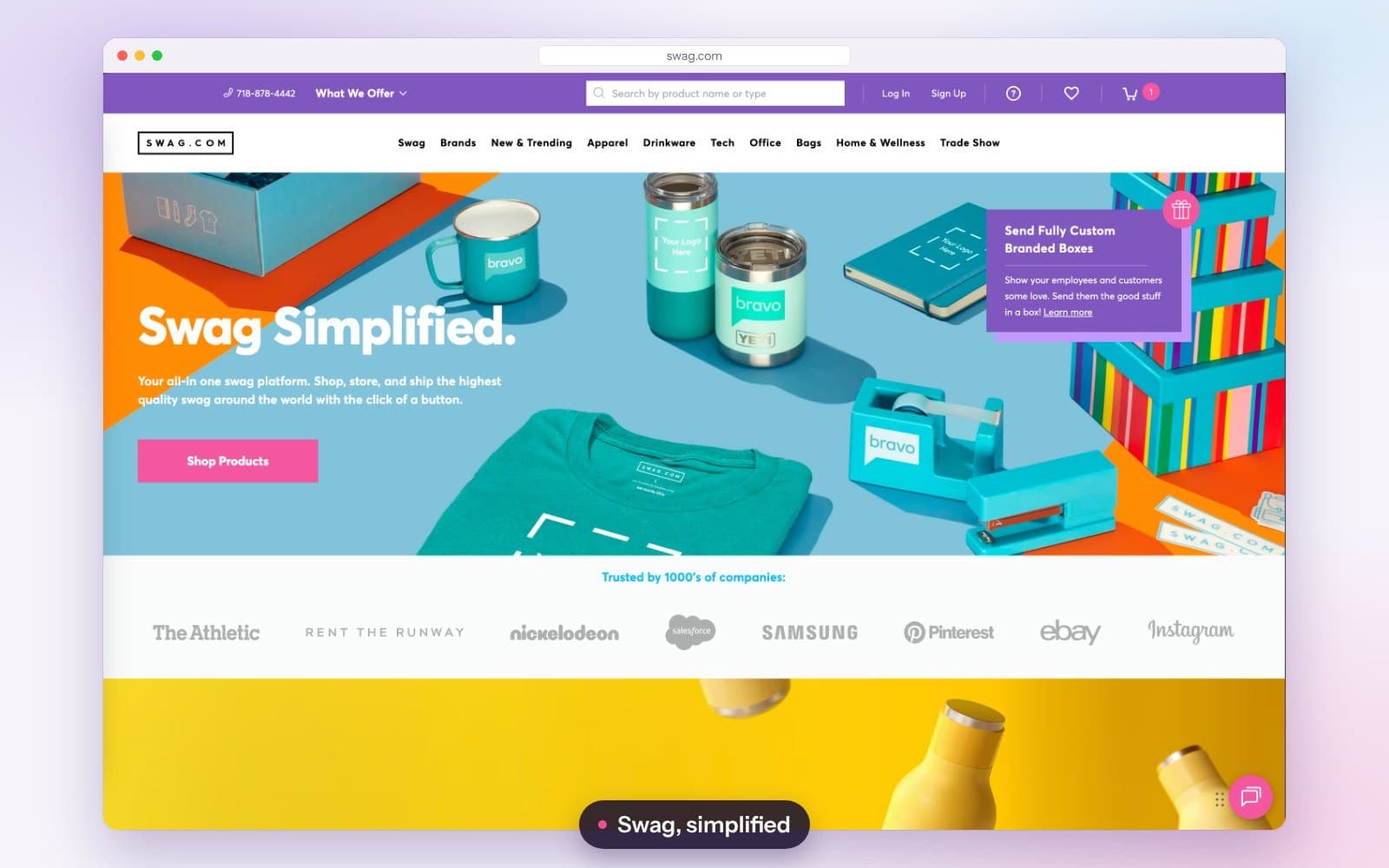
Swag.com today: pick a product, add your logo, store it, ship it anywhere.
in a row on the Inc. 5000 list of fastest-growing US companies, #218 and then #368
2 years
businesses served, from Facebook and Google to local coffee shops
~20,000
growth in 2020, driven by the inventory platform we built, while the promo industry shrank
2×
in annual sales by 2021, up from about $300,000 in the first year
$30M+

The problem

A $25 billion industry still run on email

We met Swag.com co-founders Jeremy Parker and Joshua Orbach in New York in September 2016. Buying branded merchandise then meant emailed quotes, endless mock-up revisions, manual invoices and sales tax, separate suppliers for blank products and printing, and someone checking a spreadsheet of addresses by hand.

Most of the industry’s 23,000 distributors spent around 80% of their time fulfilling orders and only 20% selling. Catalogs ran to thousands of pages of near-identical mugs.

Swag.com’s bet was the opposite: a short, curated list of products people actually keep, and software that does the busywork.

“It takes all of the manual process of traditional swag buying, and we’ve automated it, streamlined it.”
Jeremy Parker, co-founder of Swag.com, on the In Clear Focus podcast
The build · 2016 — today

Building Swag.com

012016 — 2018

A store that makes the mock-up for you

The first version had to launch fast and still last. We shipped the product catalog, a product builder that places your logo on the item in seconds, checkout and the order-processing flow, on a stack chosen to scale with the business.

In 2017 Aleph One invested $50,000 in Swag.com alongside its pre-seed round. By the end of that year Facebook and WeWork were ordering through the platform.

022017 — 2021

Scaling the team from 3 to 42 engineers

As demand grew, so did the team. We hired, led and shaped it: reorganised QA around automation, introduced Scrum for accurate planning and roadmap delivery, and added leadership roles as the team grew so communication stayed fast and bureaucracy stayed low.

The result was a team with high talent density and retention, which let Swag.com keep increasing its investment in technology without losing return on it.

032019

The online swag closet

The idea came from a visit to a client’s office, where Jeremy saw HR and office managers packing swag kits by hand. What if Swag.com stored the merchandise and shipped it, one box or a thousand, whenever the customer asked?

We turned that into the inventory platform. Companies keep stock in shared “closets”, give HR, marketing and office teams in different cities their own permissions, move inventory between closets, add approval steps, and ship to a list of addresses by uploading a single CSV.

042020

The trade shows stopped. Swag.com doubled.

The pandemic sent everyone home and cancelled every conference, the industry’s biggest channel. Swag.com doubled down on the inventory platform we had launched a year earlier, and companies used it to ship swag straight to remote employees, customers and leads.

While the promo industry declined, Swag.com’s business grew more than 100%, and it made the Inc. 5000 two years in a row.

2020 growth
+100%
while the industry shrank
Inc. 5000 · 2020
#218
fastest-growing US companies
Inc. 5000 · 2021
#368
1,308% three-year growth, Inc. 500 tier
052019 — 2021

A product line, not just a store

  • Swag in a Box. One of the first kit-building experiences in the industry. It took three implementations to get right, and became a major source of revenue.
  • Giveaways. Send a link and let people pick their own gift, drawn from the company’s inventory.
  • Swag Automation. A public API, a Zapier integration and a Shopify app, so customers can trigger shipments from the tools they already use.
  • Multi-tenant architecture. Fully white-labelled stores for partners such as Postal and Sendoso, fulfilled by Swag.com.

2021 · The outcome

Swag.com joins Custom Ink.

Five years after the first version went live, and a year after Swag.com doubled while the rest of the industry shrank.

Looking back

What made it work

  1. 01

    Start from the customer’s problem

    The inventory platform began with office managers packing boxes by hand, not with a feature list. Most of what we built came straight from customer feedback.

  2. 02

    Grow the team without slowing down

    From 3 to 42 engineers, with QA automation, Scrum and new leadership roles added as the team grew, so speed and quality held up.

  3. 03

    Build for the next opportunity

    Architecture decisions like multi-tenancy turned new ideas, from white-label partner stores to a Shopify app, into weeks of work instead of new platforms.

What they said

“They’re very passionate about the idea. It’s not just a job to them. They feel like a part of the team.”
Jeremy Parker — Co-founder and CEO, Swag.com
“The AlephOne team is one of the best tech teams I have worked with. I am impressed by the volume of work the team is able to accomplish, and the quality of the work released.”
Geeta Arora — General Manager, Swag.com

Tech stack

AWSJavaScriptNode.jsReactMongoDBPostgreSQLRabbitMQRedisShopify appPublic REST APIZapier

Bring us
the hard part.

Complex platforms, overdue rewrites, agentic workflows. That’s the work we enjoy most.

Contact Us