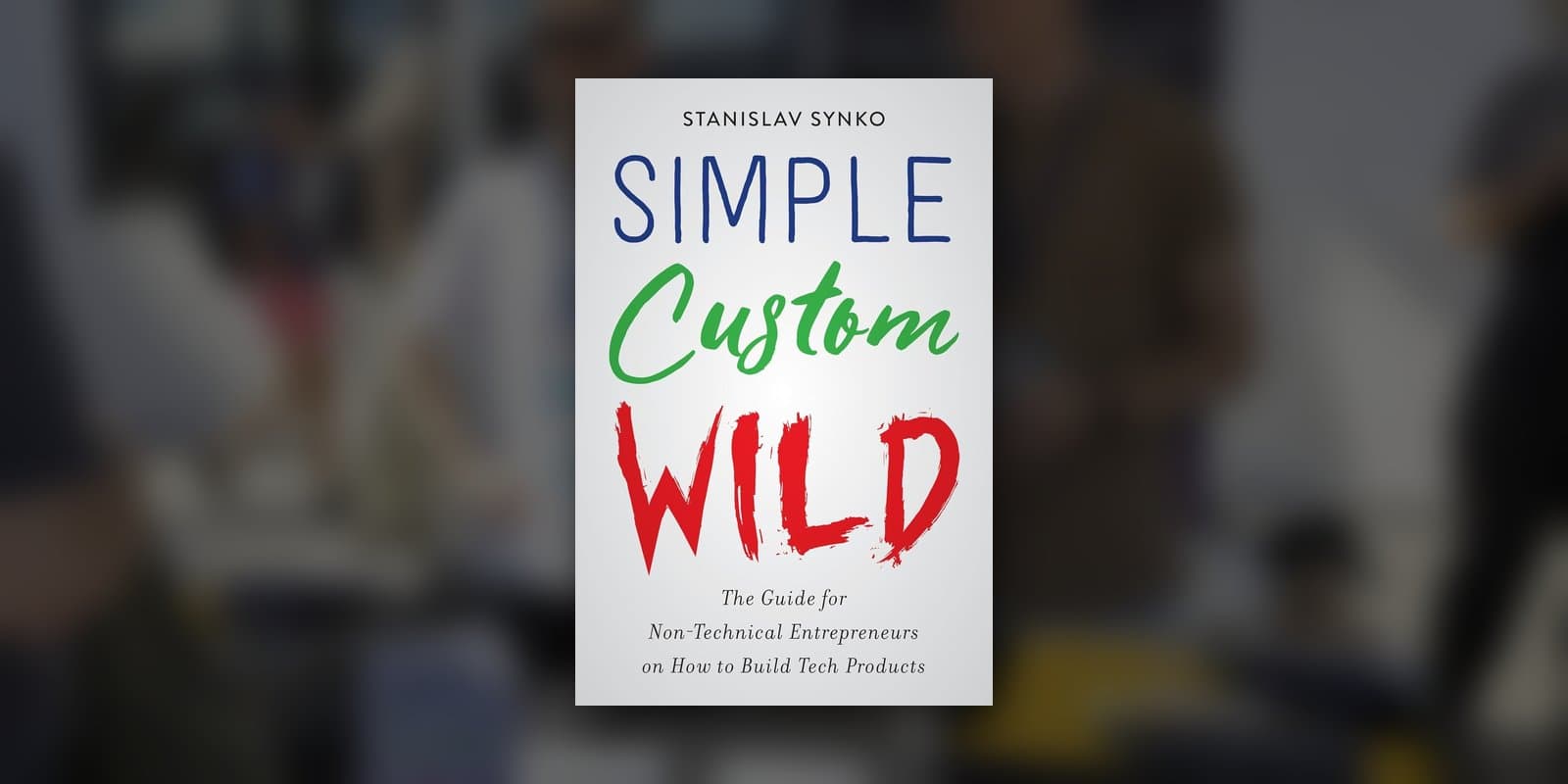
Every founder eventually has to hire someone to build something they don’t understand. Simple Custom Wild, by Aleph One CEO Stanislav Synko, is a practical guide to getting that moment right, written for entrepreneurs who are experts in their market but not in technology.
The book draws on years of building and investing in start-ups at Aleph One. It is available on Amazon. Stanislav announced the launch with this short video:
The Founder’s Dilemma
The book opens with the story of SWAG.COM. Its founders hired a development firm to build their store on a popular drag-and-drop platform. Three months and $25,000 later, with the site 95% complete, they were told the platform could never support the dynamic pricing their business depended on.
Aleph One rebuilt the platform on a custom backend and later invested in the company. SWAG.COM went on to earn over $40 million in sales in 2022 and was acquired by Custom Ink. The lesson Stanislav draws is that the costliest mistakes aren’t made in code. They are made earlier, when a founder misjudges what kind of product they are building.
“No matter what kind of business you’re in, and what amazing skills you have, at some point you’ll have to hire someone to do something you don’t understand.”
Simple, Custom or Wild
At the heart of the book is a framework that sorts every tech product into one of three tracks:
- Simple: something you can build with existing, out-of-the-box tools. It costs hundreds or thousands of dollars, not hundreds of thousands, and doesn’t need a CTO.
- Custom: your own software platform, giving you an edge in an established industry with a proven business model. It needs skilled engineers and someone who carries the CTO’s responsibilities.
- Wild: the invention of a new business model or a new technology. It needs, in Stanislav’s words, “nothing less than technical genius and millions of dollars,” and an in-house CTO.
Getting the type wrong is where start-ups lose a year or their runway. Founders over-build a Simple product while a competitor launches on no-code in two weeks. They hold a Custom product together with plug-ins “like wearing clothes that are held together with a single, fraying piece of thread.” Or they add “a dash of blockchain” to an idea that doesn’t need it.
What’s inside
From there the book follows a product from idea to scale, one decision at a time:
- Simple tech done right: domains, website builders, internal communication, security basics, and the automation and AI tools that save a small team hundreds of hours.
- Finding technical leadership: the six responsibilities of a CTO, why you shouldn’t hire one too early, the pros and cons of friends, engineers, agencies and venture studios, and the “hit 3 out of 5” checklist for candidates.
- Specs and the MVP: turning the product in your head into a prioritised spec, and why the ideal MVP reaches the market in two to three months.
- Hiring an agency: how to check expertise, portfolios and references, plus the red flags: cut rates, flat fees, exotic tech and a 12-hour time difference.
- Infrastructure: taking a product from MVP to production, stabilising it before scaling, and keeping technical debt under control.
- The Wild West: AI and AGI, blockchain, AR/VR, quantum computing and gene editing, each judged by one test: does it have practical utility?
“It doesn’t matter how cool or complex a new technology is, if it doesn’t have practical utility to an expansive user base, it is worthless.”
Who it’s for
Simple Custom Wild is written for first-time and solo founders without a technical co-founder, and for business leaders who have to make technology decisions anyway. It doesn’t try to teach you to code. In Stanislav’s words, the goal is “to inspire you to become a little bit more technical and to be more confident about the areas of your product that you don’t know, yet.”
The book ends with a habit rather than a theory: a monthly tech strategy meeting led by your CTO or tech partner. It comes with the questions to ask there, about team morale and technical debt, competitors and defensibility, data, security, budget and salaries.
Looking ahead
The book closes with a prediction: AI and no-code tools will turn many Custom products into Simple ones, and tech teams will get smaller. As that happens, the questions it teaches founders to ask (what kind of product is this, who should build it, what should it cost) will matter more, not less.